You watch a transformer explainer on YouTube. It clicks. You follow a chatbot tutorial, get something running locally, feel good for a day. Then you hit vector databases and embedding models and the tutorial skips straight to "pip install langchain" without explaining why chunk size matters.
So you open a different playlist. Three months later you can explain self-attention at a whiteboard but you cannot deploy a RAG app, estimate inference cost, or debug why your retrieval returns irrelevant chunks. The content was not bad. The path was scattered.
Skimming vs Studying — the Gap Nobody Names
Blog posts and short videos teach one concept well. A curriculum teaches a stack — what comes before what, and why skipping a step shows up as confusion later.
Jump to RAG without understanding embeddings and you treat vector search like magic. Jump to agents without tool-calling basics and your "autonomous workflow" becomes a loop that calls the wrong API twice. Jump to deployment without evaluation and you ship a demo that hallucinates on the one question your client always asks.
You do not need to abandon tutorials. Use them to fill gaps. But if your goal is to build and ship AI systems — not just talk about them — you need an ordered path with labs, not a bookmark folder of unrelated highlights.
A Sensible Learning Order
This is the sequence we recommend. It maps to the volume structure in Codextroop AI Curriculum, but the logic applies whether you use our material or assemble your own.
1. Foundations, Python, and Math (Volumes 01–03)
AI history and problem types matter less than you think day one. Python and basic math matter more than most people admit. If you cannot read a loss curve or debug a shape mismatch in NumPy, every ML tutorial becomes copy-paste until something breaks silently.
2. Machine Learning, Then Deep Learning (Volumes 05–06)
Resist jumping straight to LLMs. Supervised learning, train/validation splits, overfitting, gradient descent — these ideas show up again inside every neural network training run. Deep learning adds the architecture layer: backprop, activations, GPU basics. Skip this and "fine-tuning" is a black box you cannot troubleshoot.
3. NLP, Transformers, LLMs (Volumes 09–11)
Tokenization, embeddings, attention, encoder/decoder design — this is the stack most modern AI products sit on. When you understand why context windows exist and what RLHF actually changes, prompt design and model selection stop being guesswork.
4. RAG and Vector Databases (Volume 14)
This is where a lot of production AI work lives today. Document ingestion, chunking strategies, embedding models, FAISS or Pinecone, LangChain or similar orchestration, reranking, citation. If you only learn one applied pattern deeply, make it this one. For a deeper technical walkthrough, see our RAG guide for developers on this blog.
5. Agents and Tool Calling (Volume 15)
Agents are not chatbots with extra steps. They need tool schemas, memory decisions, error handling, and guardrails when the model picks the wrong function. Learn this after RAG — retrieval grounds answers; tools let systems act.
6. Deployment, Evaluation, Security (Volumes 18–20)
Demos and products diverge here. FastAPI services, Docker, GPU tier choices, latency budgets, BLEU/ROUGE/perplexity where they apply, hallucination checks, prompt injection and governance. This is what separates "works on my laptop" from "works for a client."
7. Capstones (Volume 23)
Read less, build more. Pick one end-to-end project and finish it before starting the next shiny topic.
Hands-On Beats Theory-Only
You learn by running code, breaking it, fixing it. Textbook depth without labs produces people who can pass quizzes but freeze when the install fails or the API response format changes.
Look for material that pairs each concept with an exercise: PyTorch tensors before custom models, LangChain chains before multi-agent graphs, a real vector database before "conceptual" embedding diagrams. Assignments that force you to change one variable and observe the result teach more than ten hours of passive video.
What a Capstone Project Actually Teaches
Take a PDF chatbot — one of the standard capstone builds. You are not just "making a chatbot." You are learning document parsing, chunk boundaries, embedding choice, retrieval quality, prompt structure for grounded answers, handling "I don't know" when nothing relevant is retrieved, and a minimal UI or API so someone else can use it.
That single project touches five volumes of theory. A multi-agent travel planner adds orchestration, tool selection, and state. A voice assistant adds STT/TTS and latency tradeoffs. Pick the capstone closest to work you want to do, not the flashiest demo.
The Ecosystem Volume Most Courses Skip
Knowing algorithms is half the job. Knowing which SDK, hosting tier, and open-weight model fits your budget is the other half.
Volume 22 in our curriculum covers the AI ecosystem — OpenAI, Anthropic, Hugging Face, Cursor, n8n, and how teams actually wire tools together. Most courses stop at "call the API." Production work needs vendor comparison, cost control, and workflow glue. That volume exists because we kept answering the same client question: "Which stack should we use?" — and the answer is never only theoretical.
How to Use a Master Index Without Overwhelming Yourself
A curriculum with 23 volumes and 500+ topics can feel like too much. The master index is not a reading list from page one to the end.
Start where your gap is. Already comfortable with Python but shaky on transformers? Open Volume 10. Built a RAG demo but retrieval quality is poor? Jump to Volume 14 and the chunking modules. Use full-text search and the A–Z index to land on a topic, not to browse aimlessly.
Study one module. Do the lab. Move on. Do not "collect" volumes like badges without building anything in between — that is the same trap as collecting tutorials, just better organized.
Certification as a Checkpoint, Not a Job Offer
The Foundation certification exam on Codextroop AI Curriculum is 40 questions, 45 minutes, free, no account required. It samples across all 23 volumes so you find blind spots — maybe you know RAG but forgot evaluation metrics, or agents but not security basics.
A downloadable PDF certificate with a reference ID is useful for LinkedIn and for your own honesty about what you have actually studied. It is not a hiring guarantee. The Professional track is coming later with a higher bar. Treat the exam like a structured review session with a score at the end.
Where to Start
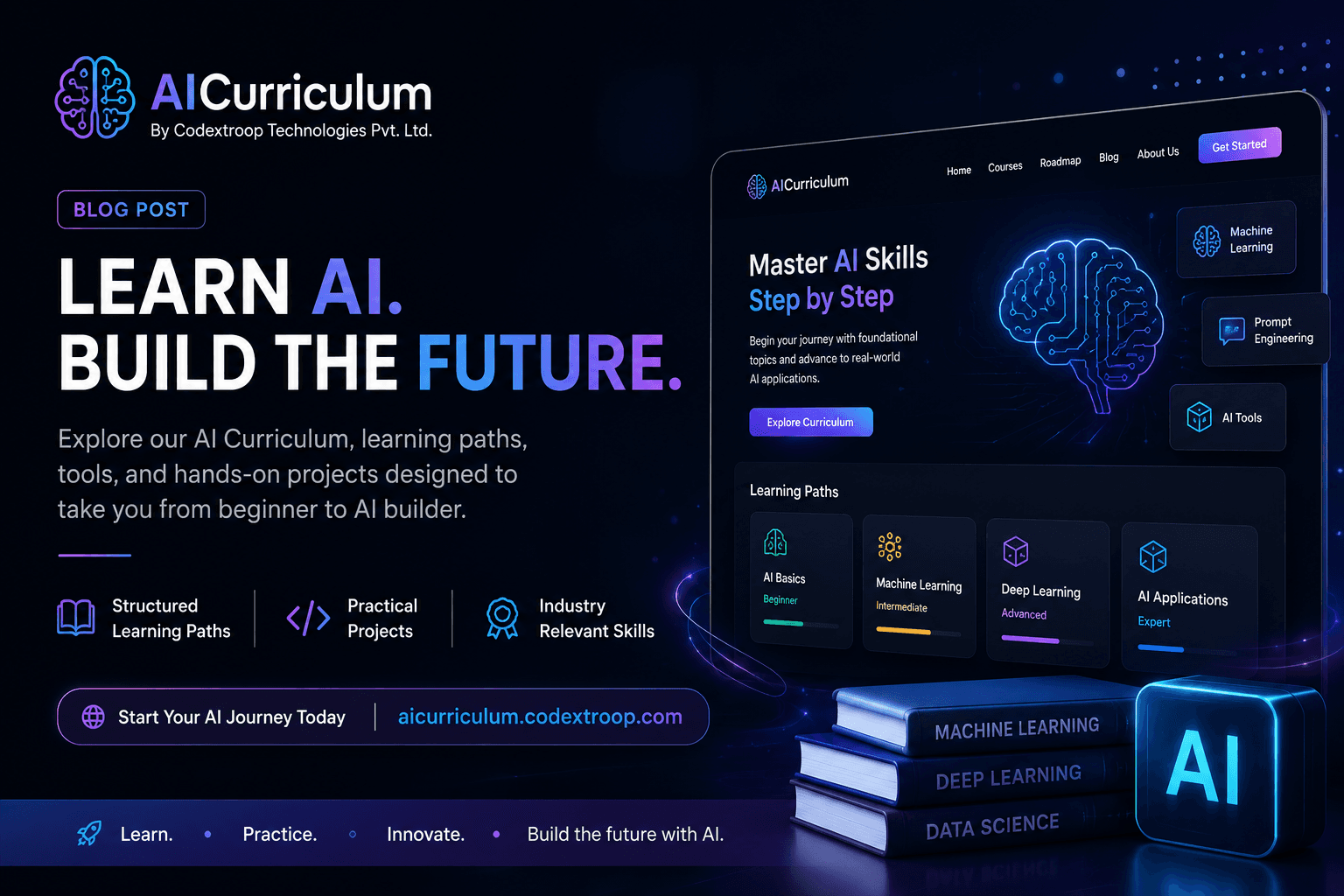
Codextroop AI Curriculum is free, no account, 23 volumes, 500+ topics, labs, and 15+ capstone projects. We are actively refining content — fixing typos, clarifying explanations, updating examples as models and tools change. It is publication-quality material meant to be studied, not skimmed like a blog series.
Open the master index, search for the topic you failed to explain last week, and do that module's lab. One gap closed beats ten playlists queued for "later."