The Challenge
Indian FMCG businesses often operate through Excel sheets, WhatsApp groups, accounting software, and disconnected systems. Procurement teams lack production visibility, warehouse teams struggle with traceability, sales teams work independently from inventory, and management has no real-time understanding of margins, wastage, or profitability.
Our Solution
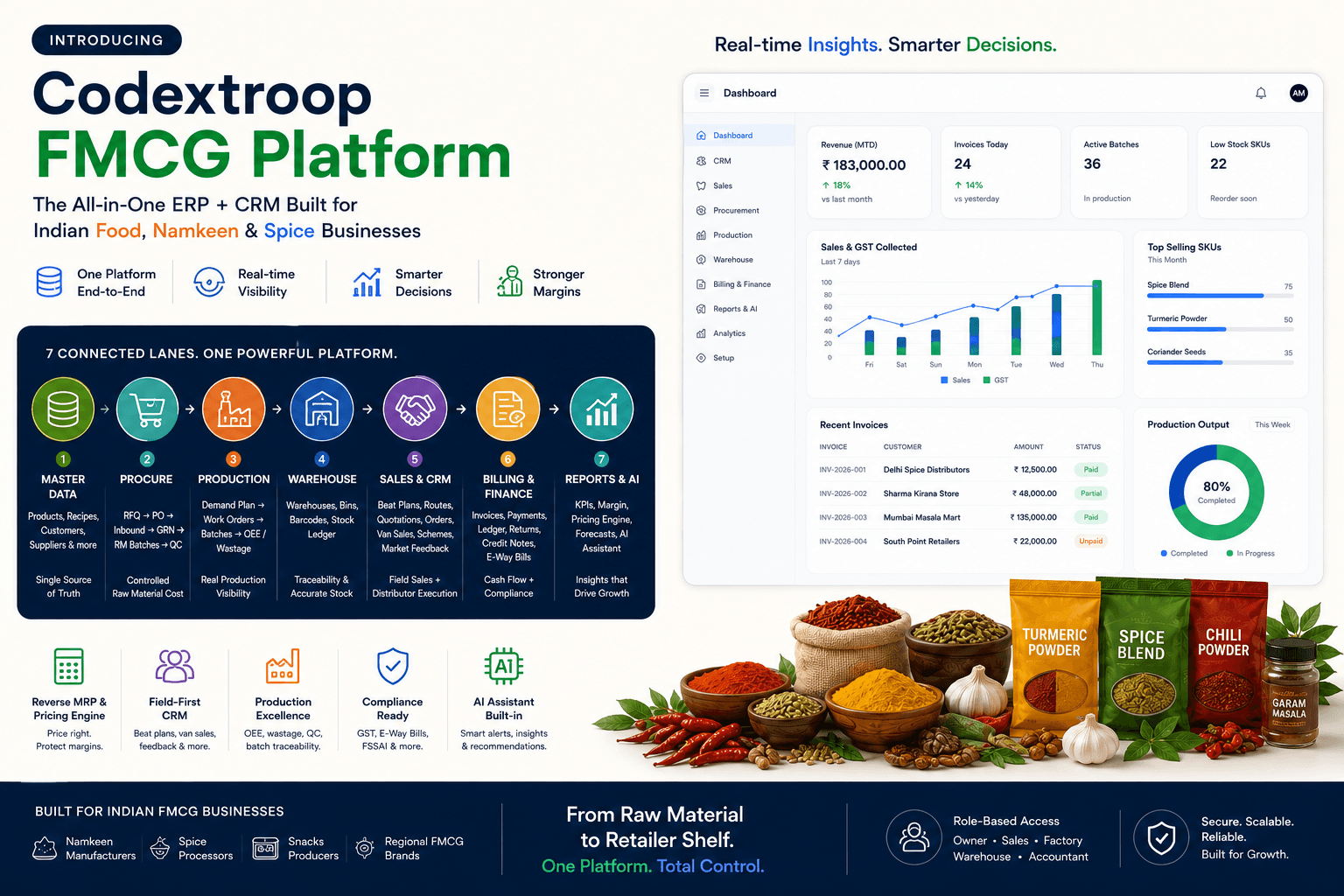
Codextroop Technologies developed TroopERP, an integrated ERP + CRM platform designed specifically for Indian FMCG businesses. The platform connects master data, procurement, production, warehousing, sales operations, billing, analytics, and AI into one continuous data flow from raw material to retailer shelf.
- Designed a 7-stage operational architecture connecting procurement, manufacturing, warehouse, sales, finance, and AI
- Built complete raw material batch and quality control workflows
- Implemented production planning with work orders, wastage tracking and OEE monitoring
- Developed warehouse traceability using barcode records and stock ledgers
- Created field sales automation including beat plans, van sales, schemes and feedback loops
- Integrated GST billing, credit notes, customer ledgers and e-way bills
- Built pricing engine for margin calculations and price revision scenarios
- Implemented AI assistant and decision engine for operational recommendations
- Developed role-based access for management, sales, production and finance teams
The Problem
Most regional spice and FMCG businesses rely on separate tools for inventory, accounting, production, sales and customer management. Procurement teams work independently from production. Sales teams lack stock visibility. Batch traceability becomes difficult and management often discovers profitability issues too late.
Designing the Platform Architecture
Instead of building another generic ERP, the platform was designed around the real lifecycle of FMCG products. Seven connected layers were created to ensure information continuously flows from procurement to production, warehouse, sales and finance while feeding insights back into planning and pricing.
Master Data Foundation
Products, raw materials, recipes, customers, suppliers and transporters form the foundation of the system. Recipes define material requirements, costs and yield assumptions which later drive production planning and pricing decisions.
Procurement and Quality Control
Raw material demand generates RFQs and purchase orders. Incoming shipments are processed through GRN workflows. Every lot is tracked using raw material batches and quality control records. Approved batches become available for manufacturing while rejected quantities automatically affect supplier ratings and inventory.
Production Planning and Batch Management
Demand planning uses sales trends and pending orders to create work orders. Material issues consume approved raw material batches. Production batches record output quantity, rejected quantity, operator details, machine utilization and wastage percentages. OEE and yield information become available for management dashboards and pricing decisions.
Warehouse and Traceability
Warehouse operations track stock movement at bin level. Barcode records and stock ledgers provide complete traceability. Every inbound receipt, production output, dispatch and return is recorded, enabling recall support and inventory accuracy.
Sales Force Automation and CRM
Sales operations include beat planning, quotations, sales orders, dispatches, trade schemes and van sales. Field representatives capture competitor observations and market feedback. Complaints and customer insights are fed back into production and pricing decisions creating a closed-loop operational model.
Finance and Compliance
Invoices, payments, ledgers, credit notes and e-way bills are integrated into the platform. Sales execution automatically creates receivables and statutory records while return workflows update stock and financial ledgers.
Decision Engine and AI Layer
Reports aggregate data from procurement, production, warehouse and sales operations. Margin reports, KPI dashboards, OEE analytics and pricing engines help management understand profitability. AI assistant modules provide summaries, alerts and recommendations based on complaints, stock levels, production efficiency and customer trends.
Business Impact
TroopERP provides complete visibility across departments, eliminates disconnected workflows and enables management teams to make decisions based on real-time operational data. The platform is designed for spice manufacturers, namkeen producers, snack brands and regional FMCG businesses seeking growth without losing operational control.
Results
TroopERP transformed fragmented FMCG operations into a connected operating platform where every department works from a single source of truth.
7
Core Business Areas Connected
100+
Functional Modules
10+
Role Based Workflows
Real-Time
Operational Visibility