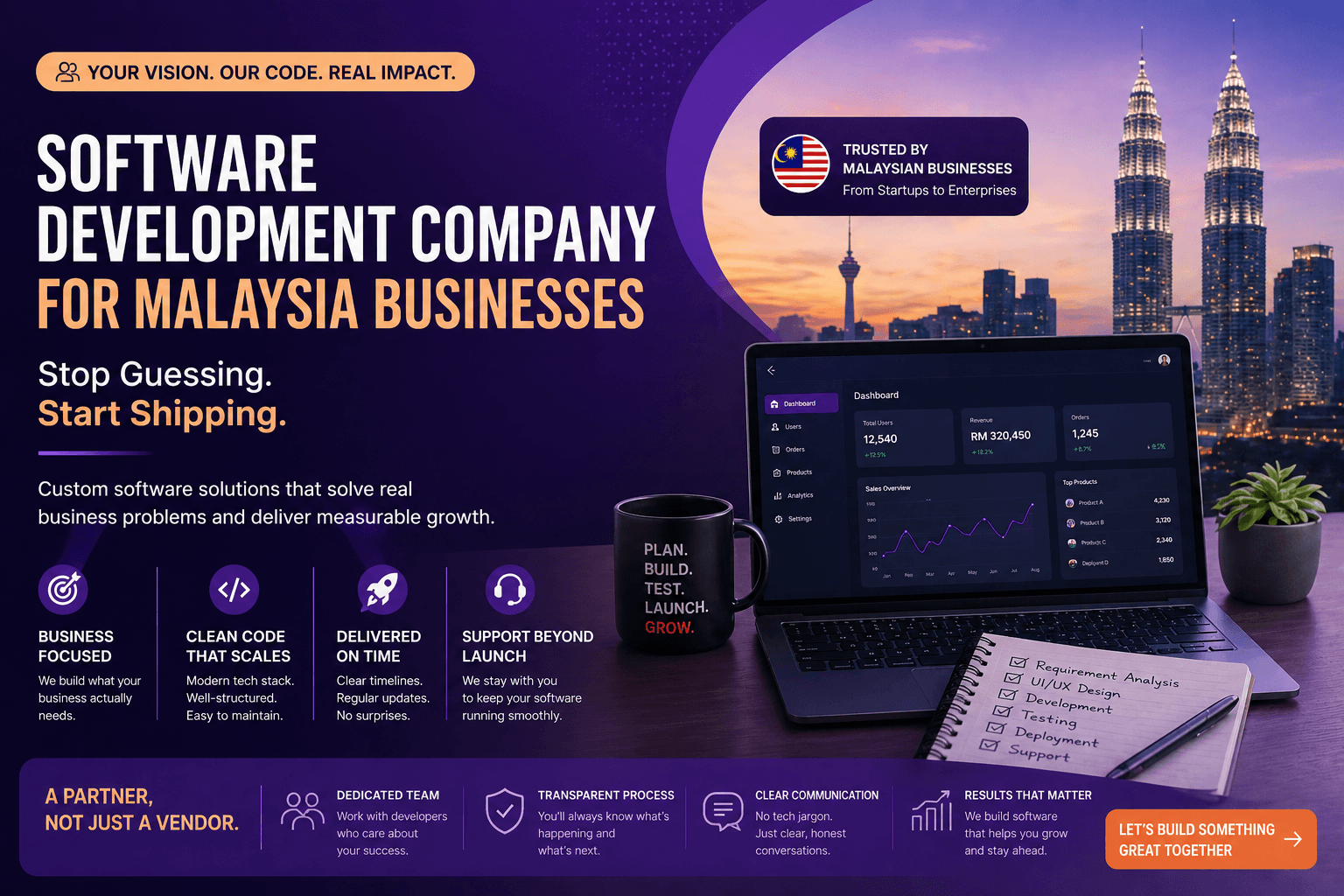
Most Software Projects in Malaysia Fail for the Same Reason
It is not the technology. It is not the budget. It is not even the idea.
Most software projects fail because the wrong company was hired to build them. And the frustrating part is it was not obvious at the start. The proposal looked good. The demo was polished. The price felt reasonable.
Then three months in, the delivery is late, the code is a mess, and you are sitting in a call trying to figure out what exactly you paid for.
This guide exists to stop that from happening to you.
What Malaysian Businesses Are Actually Building Right Now
The software landscape in Malaysia has shifted significantly in the last few years. Digital adoption accelerated. Businesses that once relied entirely on manual processes are now looking for custom software to run their operations, serve their customers, and compete regionally.
Here is what we see Malaysian businesses building most often:
- Operations and inventory management systems: Replacing Excel sheets that have become impossible to maintain. Custom-built tools that fit exactly how the business runs.
- Customer-facing web applications: Booking systems, client portals, order tracking, service request platforms. Anything that currently requires a phone call or WhatsApp message.
- E-commerce platforms: Not just Shopify setups but fully custom storefronts with complex product configurations, local payment gateways, and regional logistics integrations.
- HR and payroll tools: Especially for companies with 50 to 500 staff who have outgrown generic software but cannot justify enterprise pricing.
- Mobile applications: Field staff apps, customer loyalty apps, delivery tracking, built for iOS and Android without maintaining two separate codebases.
- SaaS products: Malaysian founders building B2B tools for the Southeast Asian market. This segment is growing fast and the ambition level is high.
If your business falls anywhere in this list you are not alone, and the solution is more straightforward than most agencies will make it sound.
Local vs Offshore: The Honest Answer
There is a common assumption that hiring a local Malaysian software company is always safer than working with an offshore team. The assumption is understandable. But it is often wrong.
Here is the reality:
- Local companies charge premium rates sometimes justified, sometimes not. Being in the same city does not automatically mean better code or better communication.
- Offshore does not mean out of reach. An Indian development company working in IST is only 2.5 hours behind Malaysian time (MYT is GMT+8, IST is GMT+5:30). You are not waiting for a different continent to wake up.
- What actually matters is process, communication, and accountability, none of which are determined by geography.
The right question is not where are they based. The right question is can they show me work they have delivered, explain how they work, and tell me clearly what I will get and when.
The Five Questions to Ask Before Signing Anything
Whether you are talking to a local KL agency or an offshore team, these five questions will tell you almost everything you need to know:
- "Can I see two or three projects you have shipped recently?" Not mockups. Not a portfolio page with screenshots. Actual live products. If they cannot show you work, that is your answer.
- "How do you handle scope changes during a project?" Every project has scope changes. How a company responds to this question tells you whether they are rigid, chaotic, or actually professional.
- "Who will I actually be talking to week to week?" If the answer is a project manager who then relays to a developer who then reports back, that chain will slow everything down. You want direct access to the person building your product.
- "Who owns the code and the repository at the end?" The answer should be: you do, unconditionally. If there is any hesitation here, walk away.
- "What happens after launch?" Bugs happen. Things break. A company that disappears after delivery is not a partner. They are a vendor. Know the difference before you commit.
Why India Works So Well as a Development Partner for Malaysia
There is a reason Malaysia and India have had strong business ties for decades. The cultural alignment, the English fluency, the timezone proximity, it is genuinely one of the most practical cross-border working relationships in Asia.
From a software development standpoint, here is what makes it work specifically:
- Technical depth: India has one of the largest pools of software engineers in the world. Finding a developer who specialises in exactly what you need, whether that is React, Python, AWS, or mobile development, is not difficult. It takes days, not months.
- Cost efficiency: Development rates in India are significantly lower than in Malaysia for comparable skill levels. This is not a quality trade-off. It is a cost-of-living difference that flows into the rate.
- Overlap hours: If your team works 9 AM to 6 PM MYT, your Indian development partner is already at their desk by 11:30 AM MYT. You have a solid 6-hour overlap every single day.
- Experience with regional requirements: Payment gateways like FPX, GrabPay, and Touch 'n Go. Multilingual interfaces for Bahasa Malaysia, English, and Chinese. An experienced team has built for this market before and knows what to expect.
What a Good Software Development Engagement Looks Like
We want to be specific here because vague promises are everywhere. A well-run project with Codextroop looks like this:
-
Week 1: Discovery and scoping
We document what you need, break it into features, agree on priorities, and produce a written scope with timelines. You approve it before anything is built. -
Week 2 onwards: Milestone-based development
Work is broken into 2-week sprints. At the end of each sprint, you see a working demo, not a progress update, actual working software. -
Ongoing: Direct communication
You have access to the developer on Slack or WhatsApp. Questions get answered the same day. You are never left waiting for a status update. -
At launch: Clean handover
Full codebase on your repository. Deployment documentation. Credentials for every service. Nothing locked away. -
Post-launch: Maintenance and support
We offer ongoing support plans for clients who want continued development or just want someone available when something needs fixing.
Budget Reality Check for Malaysian Businesses
Let us talk numbers, because nobody else will.
Software budgets in Malaysia vary wildly depending on what is being built. Here is a rough guide to set realistic expectations:
- Simple website or landing page: RM 3,000 to RM 8,000 (roughly USD 750 to USD 2,000). Anything below this from a professional team should raise questions about what is being cut.
- Web application with a backend and database: RM 15,000 to RM 60,000+ (roughly USD 3,800 to USD 15,000+) depending on complexity, integrations, and number of user roles.
- Mobile application (iOS + Android): RM 25,000 to RM 80,000+ (roughly USD 6,300 to USD 20,000+). React Native brings this cost down significantly compared to building two native apps separately.
- SaaS product MVP: RM 30,000 to RM 100,000+ (roughly USD 7,500 to USD 25,000+). This covers core features, authentication, billing integration, and deployment. Not a finished product, a launchable version to validate with real users.
These are ranges, not quotes. Every project is different. But if someone is offering to build your full web application for RM 5,000, they are either cutting corners or they do not understand what they are building.
Red Flags That Are Easy to Miss
A few things that look harmless at first but cause problems later:
- No written scope document: If a company jumps straight from call to contract without documenting what they are building, every disagreement later will be a "that was not part of the plan" conversation.
- Full payment upfront: Professional teams work on milestone-based payments. Asking for 100% before writing a single line of code is not standard practice.
- No staging environment: If you cannot review the product before it goes live, you have no control over what gets deployed. This is basic, and some teams skip it entirely.
- Promising everything in the first call: Good developers ask hard questions before committing. If someone agrees to everything without pushback, they either do not understand the project or they are telling you what you want to hear.
How Codextroop Works With Malaysian Clients
We have worked with businesses across Malaysia and Singapore across a range of industries, logistics, retail, HR tech, F&B, and professional services. The context is always different. The fundamentals are always the same.
We cover everything from initial scoping to post-launch maintenance:
- Custom web application development
- Mobile application development (React Native)
- SaaS product development from MVP to scale
- API development and third-party integrations
- Dedicated developer hiring for ongoing teams
- UI/UX design for web and mobile products
We work with founders, operations managers, and CTOs. Some clients come with detailed specs. Some come with a problem and no idea how to solve it technically. Both are fine starting points.
The Bottom Line
Malaysia's business environment is competitive and moving fast. The companies that are pulling ahead are not necessarily the ones with the biggest budgets, they are the ones that made smart technology decisions early and built systems that actually support how they operate.
A good software development partner does not just write code. They ask the right questions, push back when something does not make sense, and stay accountable for the outcome, not just the delivery.
If that is what you are looking for, reach out to Codextroop and let us start with a straightforward conversation about what you need to build.